
A True Job Match and Why It Matters: Part 1
Every food dish is made up of several individual, standalone ingredients.
Each ingredient has its own flavor and characteristics, but when they are combined, they create the overall experience.
A job is a lot like a food dish.
It is not one simple thing. It is a combination of individual components that come together to create the complete experience of the role.
To thoroughly understand the true nature of a job, a young person needs to examine all of its individual components.
After all, you may really like rosemary, but that does not mean you would enjoy every dish containing rosemary. Before deciding to try a dish, you would probably want to know the other ingredients it contains.
The same is true of a job.
A young person may like one of its components.
They might enjoy a subject it involves, feel drawn to a particular activity, or believe they would be good at one of the required skills.
But liking one component does not mean they’d enjoy the entire job.
The really important question, then, is this:
What are the ingredients of a job that should be discovered to gain a comprehensive understanding of the role?
Job Anatomy
I’d like to suggest that there are four core ingredients that make up a job’s anatomy.
A job is a set of Skills, applied to Content, in a particular Setting, to achieve a specific Outcome.
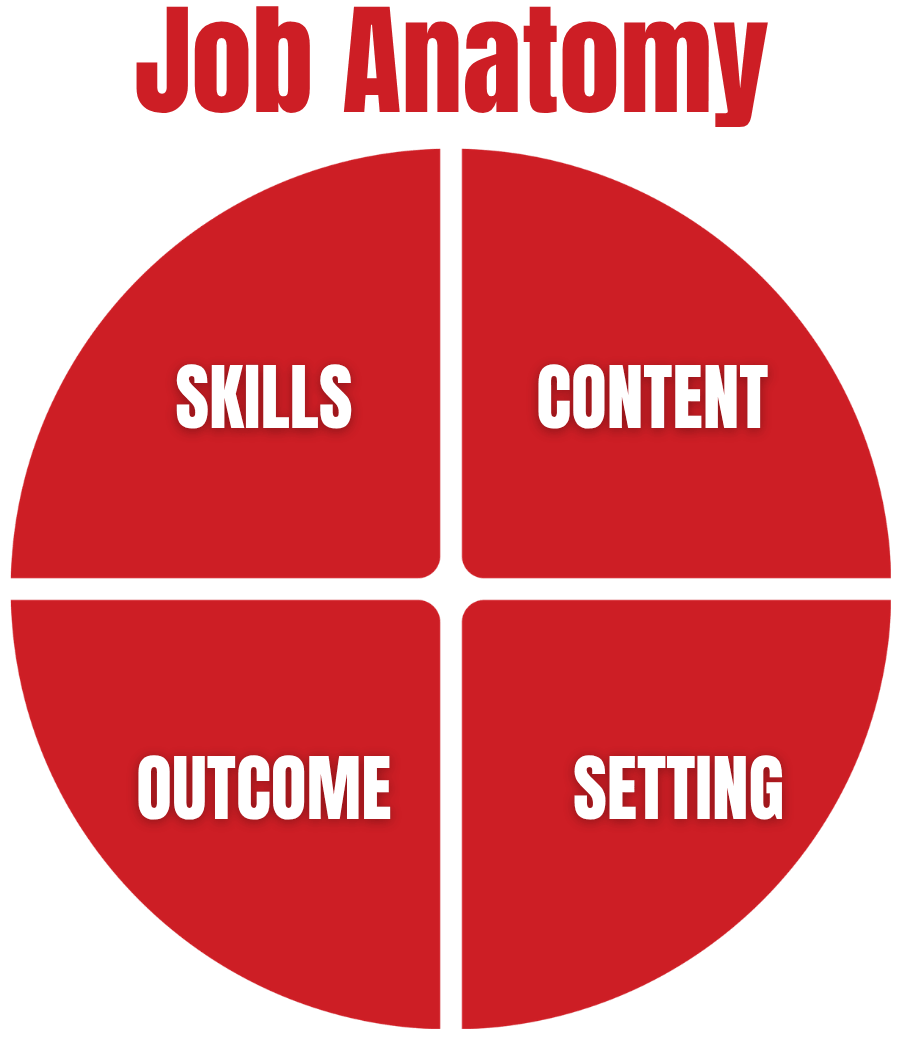
Let’s take a closer look at each of these four ingredients.
Skills: What Must You Be Able to Do?
Skills are the abilities a person must use to perform the work successfully.
These can include technical skills connected to the occupation and people skills needed to communicate, collaborate, lead, serve, or solve problems.
For example, a job might require someone to analyze information, organize details, explain ideas, solve problems, repair equipment, persuade people, design something, or care for others.
Skills answer the question:
What must I be able to do well?
Content: What Are You Working With?
Content represents the subjects and objects a person works with regularly.
This might include information, ideas, numbers, people, animals, tools, machines, materials, technology, or systems.
Content is often the first component a young person notices. A teen who enjoys science may begin looking at science-related careers. A teen who likes animals may start thinking about jobs involving animals.
That interest can be a useful starting point, but Content is only one ingredient within the complete job.
Content answers the question:
What will I be working with throughout the day?
Setting: What Is the Job’s Environment Like?
Setting refers to the context in which the work takes place.
It includes the physical environment, pace, pressure, structure, schedule, amount of movement, level of interaction, and whether the work is performed independently or with others.
Some jobs take place in quiet, predictable environments. Others involve frequent interruptions, tight deadlines, constant interaction, physical activity, or rapidly changing demands.
These conditions are not separate from the job. They are part of it.
Setting answers the question:
What is the environment in which the work is accomplished?
Outcome: What Is the Work Accomplishing?
Outcome is the primary purpose of the work and the result a person’s effort is intended to produce.
It might involve helping someone recover, solving a problem, improving a process, protecting an organization, creating something useful, or providing people with an important service.
Two people can perform similar activities but feel very differently about the work because they are motivated by different results.
Understanding the Outcome helps a young person see what their effort will ultimately accomplish.
Outcome answers the question:
What will my work accomplish?
Four Components, One Complete Job
Skills, Content, Setting, and Outcome are individual components, but they come together to create one complete job experience.
A person does not use Skills in isolation. Those Skills are applied to particular Content, within a particular Setting, to achieve a particular Outcome.
That is why a job cannot be understood by examining only its title, its most visible activity, or the subject associated with it.
A young person needs to understand all four components.
Ultimately, all four must align with the young person’s innate wiring for the job to represent a strong overall match. Identifying the components is the first step.
Examining that alignment is the next.
The Bottom Line
A job is more than a title.
It is also more than one appealing subject, activity, or responsibility.
Every job has an anatomy consisting of four core components:
Skills: What must I be able to do well?
Content: What will I be working with throughout the day?
Setting: What is the job’s environment like?
Outcome: What will my work accomplish?
Together, these four components create the complete experience of doing the work.
Before your teen decides that a job sounds appealing, encourage them to look beyond its title and examine all four parts of its Job Anatomy.
Parent Reflection
This question is designed to help you pause and clarify your own thoughts, assumptions, and opinions about the issue raised in today's email.
When you have encouraged your teen to consider a particular career, which components of Job Anatomy have you emphasized, and which have you rarely considered?
This question matters because parents can unintentionally focus on the most visible part of a job, such as its subject, title, reputation, or salary. Recognizing what may have been overlooked can lead to more complete career conversations.
Start a Convo
Use the following questions to start a conversation with your teen about today’s topic.
Before asking the questions, briefly explain that Job Anatomy consists of the four components that create the experience of doing a job: Skills, Content, Setting, and Outcome.
- Do you think most teens understand what a job involves beyond its title and main subject?
- When a job sounds interesting, which part of its Job Anatomy do you usually notice first?
- How might looking at all four components change the way you explore a career?
In the Next Post
Identifying the four components of Job Anatomy gives your teen a clearer picture of what a job actually involves.
But knowing the ingredients is not enough.
The next question is whether each ingredient fits the person who will be doing the work.
In the next post, we'll explore what each component must align with and why the complete combination matters when evaluating a potential job.
Right to Your Inbox
Would you like this content conveniently delivered right to your inbox? Join the LA12 community through the footer below.
A True Job Match and Why It Matters
Part 1: Every Job is Only These Four Things (CURRENTLY READING)