
Why Your Teen Needs a Job ASAP: Part4
In the last email, we looked at how starter jobs can help teens build Transferable Skills they can carry into future jobs, internships, programs, and careers.
Today, we're going to look at the third World-of-Work Asset they produce:
Resume-Building Accomplishments.
And this matters because simply having a job is not always enough.
Future employers, internship coordinators, scholarship committees, and admissions officers often want more than a list of activities.
They want evidence of what a teen actually did with the opportunities they were given.
Experience Is Good. Proof Is Better.
Many teens believe simply having a job will automatically help them stand out.
And it can help.
But experience alone is not always enough.
When someone evaluates a young person for a future opportunity, they are often trying to answer one important question:
How do I know this person will create value here?
That question matters.
Because two teens can hold the same job title, work in the same kind of business, and spend the same number of hours on the job, yet walk away with very different levels of value.
One teen may simply complete assigned tasks.
Another teen may learn, improve, take initiative, solve problems, earn trust, and create measurable results.
The difference is not just experience.
The difference is evidence.
Not All Experience Is Created Equal
One helpful way to understand this is to look at three possible ways the same job experience might appear on a resume:
- Experience
- Activity
- Accomplishmen
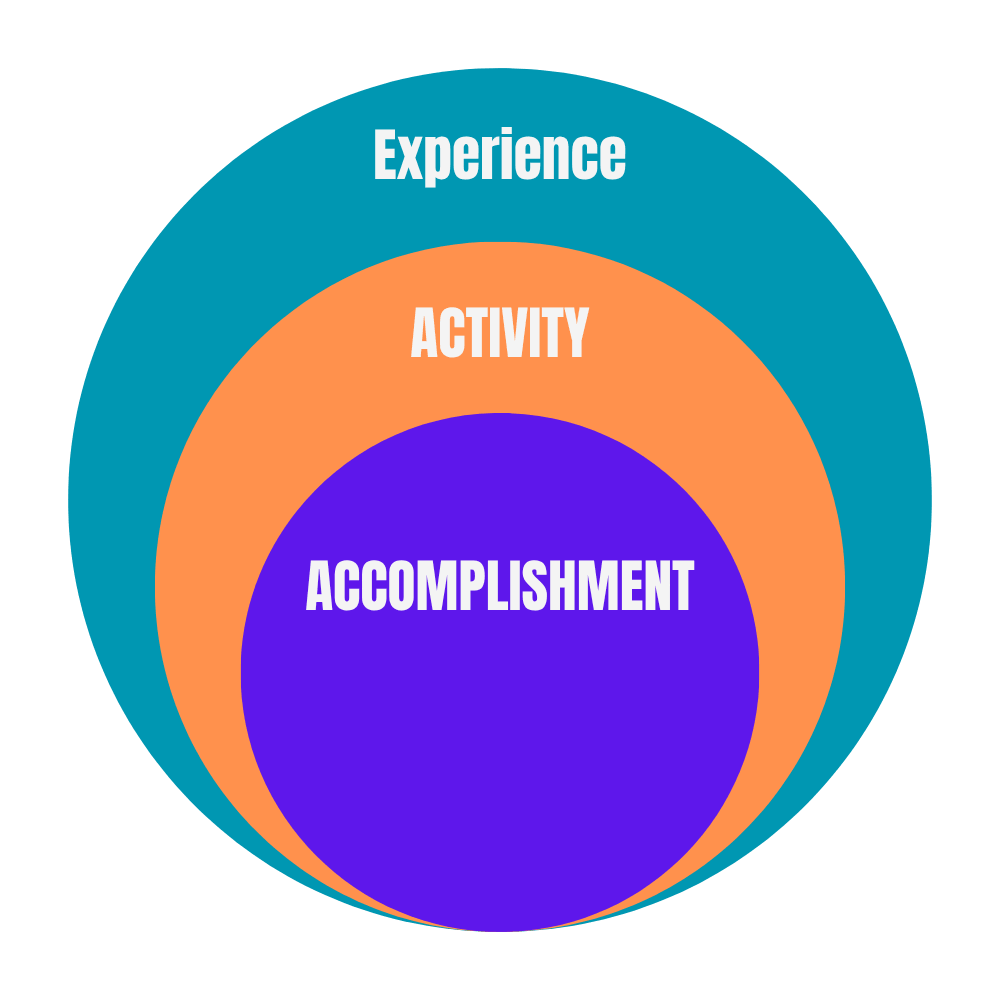
Each level tells a different story.
Experience
Resume content: Served as a customer service representative.
This tells us where someone worked or what position they held.
That is useful, but it is limited.
It does not tell us what the person actually did, how well they did it, or what value they created.
Activity
Resume content: Interacted with customers on the phone who had questions or problems about purchased products.
This tells us more.
Now we know something about the kind of work the person performed.
But it still does not tell us whether they were effective. It describes responsibility, not impact.
Accomplishment
Resume content:
- Improved department ratings by 27%
- Consistently handled 500+ calls daily (21% above average)
- Developed a script system for addressing common problems that was adopted for the entire department
This tells a much stronger story.
It shows action.
It shows responsibility.
It shows measurable value.
It shows that the person did more than occupy a role.
They contributed.
That is what makes accomplishments powerful.
They turn experience into proof.
Employers Look for Evidence
The National Association of Colleges and Employers identifies communication, teamwork, critical thinking, professionalism, leadership, and technology as part of career readiness, the competencies that help prepare people for success in the workplace.¹
But future employers are not simply looking for people who can name those skills.
They are looking for people who can demonstrate them.
That is why accomplishments matter.
An accomplishment helps answer questions like:
Did this teen take responsibility?
Did they solve a problem?
Did they improve something?
Did they earn trust?
Did they contribute to a team?
Did they create value?
Those questions matter because they move a teen beyond simply saying, "I worked there."
They help a teen say, "Here is what I learned, how I contributed, and what I can bring to the next opportunity."
Use Starter Jobs to Create Accomplishments
One misconception is that accomplishments only happen in impressive jobs.
That is not true.
Accomplishments can be built in ordinary starter jobs when teens learn to take responsibility, notice problems, improve processes, help people, or earn trust.
A restaurant job might lead to accomplishments such as:
- Being trusted to train new employees
- Receiving positive customer feedback
- Taking on additional responsibilities during busy shifts
A retail job might lead to accomplishments such as:
- Resolving difficult customer situations
- Improving store organization
- Earning recognition for reliability or performance
A front desk or administrative support job might lead to accomplishments such as:
- Learning new systems quickly
- Improving how information is organized
- Taking ownership of important recurring tasks
The specific accomplishment will look different from job to job.
But the larger lesson is the same.
A teen can learn how to create value wherever they work.
Accomplishments Become Future Opportunities
Every accomplishment creates something valuable.
A story for an interview.
A bullet point for a resume.
An example for a scholarship application.
A talking point during a college interview.
A reason for a manager to provide a strong recommendation.
That is why parents should not think of a starter job only as a way to collect a paycheck. It can also be a place where a teen begins collecting evidence.
Going to work can result in meaningful accomplishments.
Those accomplishments become proof. resume content.
That proof becomes noteworthy resume content.
And that powerful resume content can help create future opportunities.
A starter job is not just a place to gain experience.
It is a place to build accomplishments.
The Bottom Line
Resume-Building Accomplishments give teens an advantage because they provide evidence of growth, responsibility, contribution, and impact.
Experience tells people where your teen has been.
Activities tell people what your teen did.
Accomplishments show the value your teen created.
A starter job gives teens the opportunity to build experience, but the real advantage comes when they learn to turn that experience into accomplishments that provide evidence of their abilities.
Experience gets your teen into the conversation.
Resume-Building Accomplishments help them stand out.
That is yet another aspect of The Starter-Job Advantage.
¹ National Association of Colleges and Employers, Career Readiness Competencies
https://www.naceweb.org/career-readiness/competencies/career-readiness-defined/
This question is designed to help you pause and clarify your own thoughts, assumptions, and opinions about the issue raised in this post:
- If your teen had to apply for a competitive opportunity tomorrow, what evidence could they provide that demonstrates their value beyond grades and activities?
The answer to that question can help parents think more clearly about whether their teen is simply participating in activities or building evidence of growth, contribution, and responsibility.
Start a Convo
Use the following questions to start a conversation with your teen about today's topic.
- Do you think most teens know how to turn a job experience into evidence of what they accomplished?
- If you had a starter job, what kind of accomplishment would you be proud to talk about later?
- How do you think being able to show proof of your growth or contribution could change the way future employers, colleges, or programs see you?
In the Next Post
In this post, we looked at how starter jobs can help teens turn ordinary work experience into Resume-Building Accomplishments.
Next, we’ll look at the fourth World-of-Work Asset: Professional Relationships.
We’ll talk about why some of the most valuable opportunities never begin with an application, why customers, managers, business owners, and older coworkers can become part of a teen’s future network, and how a starter job can help your teen build references, recommendations, mentors, and connections before they urgently need them.
Some doors open because of what your teen has done. But others open because someone knows them, trusts them, and is willing to speak on their behalf.
Right to Your Inbox
Conveniently delivered right to your inbox? Join the LA12 community through the footer below.
Why Your Teen Needs a Job ASAP Series
Part 1: The Starter-Job Advantage
Part 2: Starter Jobs Give Teens the Real-World Experience Employers Increasingly Expect
Part 3: Starter Jobs Build Critical Skills That Travel
Part 4: Using Starter Jobs to Create Powerful Resume Content (CURRENTLY READING)